
CJI Surya Kant Rejects Opposition Plea: Exclusive Judicial Stance
CJI Surya Kant has declined a meeting request from Opposition leaders regarding SIR and CEC Gyanesh Kumar, citing judicial propriety and legal standards.
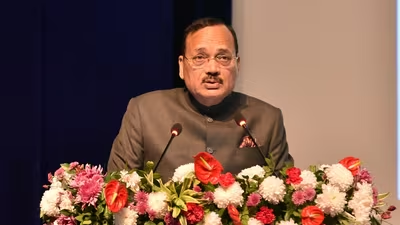
Supreme Court judge cji surya kant has formally declined a request from a group of opposition leaders seeking a private meeting. This request centered on concerns regarding the ongoing SIR exercise and the appointment of CEC Gyanesh Kumar. Maintaining the integrity of the bench, the judge underscored that such interactions fall outside established legal protocols.
The refusal reflects a firm adherence to judicial propriety. By keeping distance from political representatives, the court aims to preserve its institutional independence. This decision highlights the importance of keeping the judiciary separate from active political disputes.
The Stance of cji surya kant on Judicial Propriety
The refusal by cji surya kant stems from a commitment to judicial propriety. Engaging in private discussions with political factions could compromise the perceived neutrality of the court. Consequently, the judge opted to prioritize formal legal channels over informal dialogue.
This approach ensures that the judiciary remains an impartial arbiter. cji surya kant signaled that grievances should be addressed through documented petitions rather than private audiences. This standard protects the court from being drawn into partisan campaigns.
Focus on Opposition Leaders Meeting and SIR Concerns
The opposition leaders meeting proposal emerged as part of a broader push against current administrative procedures. These politicians have expressed deep skepticism regarding the integrity of the SIR exercise. They argue that the process requires closer judicial scrutiny to ensure fairness.
Specific points raised by the coalition include
- Allegations regarding electoral roll irregularities that could impact voter representation.
- Questions surrounding the administrative conduct of CEC Gyanesh Kumar.
- Requests for an independent review of current data collection methods.
These concerns form the core of the opposition's ongoing campaign. By seeking an audience with cji surya kant, they hoped to highlight these issues directly. However, the court has maintained its focus on objective legal procedures.
Addressing Allegations Against CEC Gyanesh Kumar
The opposition has frequently voiced distrust concerning the role of CEC Gyanesh Kumar. Their primary contention involves the transparency of his recent actions. They allege that the SIR exercise lacks sufficient oversight.
These claims of electoral roll irregularities remain a central pillar of their narrative. According to these leaders, the current system is prone to manipulation. They believe that a meeting with cji surya kant would have provided a path toward addressing these perceived failures.
Despite these requests, the judicial process dictates that such matters must follow standard litigation paths. cji surya kant remains committed to the principle that judges should not be influenced by external political pressure. This firm boundary ensures that CEC Gyanesh Kumar and other officials are evaluated only within the framework of the law.
Ultimately, the refusal reinforces the separation of powers. By declining this meeting, cji surya kant has upheld the requirement for institutional distance. All parties must now rely on formal filings to resolve these ongoing disputes. The court continues to stand as a neutral entity in this evolving political landscape.
More updates
Follow the latest India news and related coverage.
What's Your Reaction?
 Like
0
Like
0
 Dislike
0
Dislike
0
 Love
0
Love
0
 Funny
0
Funny
0
 Wow
0
Wow
0
 Sad
0
Sad
0
 Angry
0
Angry
0

Rina Chatterjee covers health, medicine and wellness with a focus on reliable, easy-to-understand information. She works to separate fact from rumor and helps readers make informed choices about their well-being. Her articles are carefully researched and written with empathy.





Comments (0)