
JWST Uncovers Hidden Giant Exoplanet Beta Pictoris d Using Advanced Spectroscopy
NASA's James Webb Space Telescope (JWST) has confirmed the existence of a third giant exoplanet, Beta Pictoris d, in the highly scrutinized Beta Pictoris system located 63 light-years away. This milestone makes it only the second directly imaged multi-planet system with three or more worlds. Rather than relying on traditional visual photography, astronomers utilized JWST's high-precision spectrographs to detect the faint planet’s unique chemical signature masked by the host star's intense glare, demonstrating a powerful new approach to archival exoplanet discovery.

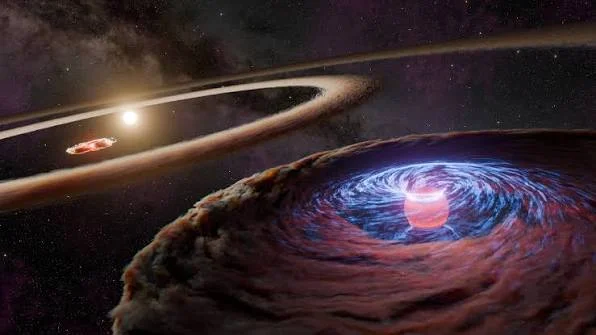
BALTIMORE — NASA’s James Webb Space Telescope (JWST) has fundamentally redefined how astronomers search for alien worlds. By leveraging advanced infrared spectroscopy rather than standard optical photography, an international team of scientists has confirmed the existence of a third giant exoplanet, Beta Pictoris d, hiding in plain sight within one of the most intensely observed planetary systems in the night sky.
Located roughly 63 light-years away in the southern constellation Pictor, the Beta Pictoris system represents a cosmic "teenager." At just 20 to 23 million years old—compared to our own Sun's mature 4.6 billion years—its turbulent debris disk is still actively churning, and its massive planets are still settling into final orbits. This dynamic environment makes it a perfect natural analogue for researchers studying how our early Solar System, particularly gas giants like Jupiter and Saturn, originally took shape.
Prior to this discovery, Beta Pictoris was already globally famous for hosting two directly imaged gas giants, Beta Pictoris b and c. The new confirmation of this third world, detailed in the Astrophysical Journal Letters, elevates Beta Pictoris into an elite category as only the second planetary system known to possess three or more directly imaged worlds, allowing scientists to observe complex long-term gravitational interactions.
Concealed by Stellar Glare
Physically, Beta Pictoris d is slightly larger than Jupiter and takes approximately 91 Earth years to complete a single massive orbit around its host star. Despite its scale, the planet managed to evade detection for more than a decade under near-constant surveillance by ground- and space-based observatories.
The primary hurdle was its extreme faintness; Beta Pictoris d is roughly 100 times dimmer than its neighboring sibling planets. Due to this low luminosity, paired with specific viewing geometries, the planet remained completely washed out by the overwhelming glare of the primary star.
A New Era of Spectrum Detection
The breakthrough came from analyzing the light's chemical composition rather than waiting for a clearer photograph. Traditional direct imaging relies almost exclusively on physical coronagraphs to block out a star's light to visually capture a planet as an isolated dot of light. Instead, the JWST research team utilized the telescope's Near-Infrared Spectrograph (NIRSpec) and Mid-Infrared Instrument (MIRI) to look for spectral data.
Instead of searching for a physical visual point, researchers scanned the infrared spectrum for molecular "fingerprints" that did not align with the signature of the host star. By treating every captured pixel as a complex layer of physical data rather than just a visual element, they successfully extracted the faint planet's data out of the blinding background light.
This methodological triumph signals a profound shift in modern observational astronomy. The reality that a Jupiter-sized planet could remain hidden for so long in an extensively scrutinized system implies that countless undiscovered exoplanets are already sitting within existing data archives. As computational pipelines and specialized spectroscopy continue to advance, astronomers may find that the next generation of alien worlds does not require building larger telescopes, but rather applying the right analytical tools to the light we have already captured.
What's Your Reaction?
 Like
0
Like
0
 Dislike
0
Dislike
0
 Love
0
Love
0
 Funny
0
Funny
0
 Wow
0
Wow
0
 Sad
0
Sad
0
 Angry
0
Angry
0










Comments (0)