
Infantino Signals Openness to Future 64-Team FIFA World Cup Expansion
Following the competitive success of the current 48-team tournament, FIFA President Gianni Infantino has signaled openness to a potential future expansion to 64 teams. Speaking with Swiss media, Infantino emphasized the importance of global representation and the structural incentives that tournament access provides to developing football nations. The proposal, which already has formal momentum from CONMEBOL for the 2030 centenary edition, faces significant scrutiny regarding player welfare and the logistical strain of expanding beyond the current 104-game schedule.

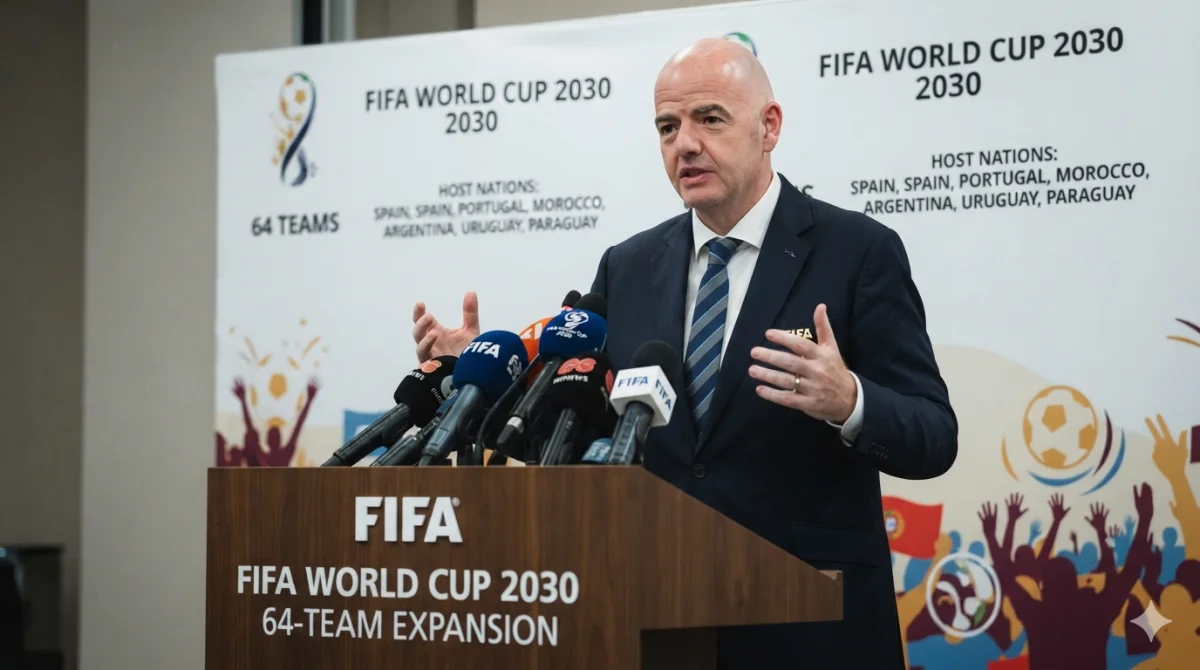
ZURICH — The sporting and commercial success of the ongoing 48-team FIFA World Cup format has rapidly accelerated conversations regarding a potential future expansion to a 64-team tournament structure.
While critics initially feared a dilution of competitive quality under the expanded 48-team bracket, the tournament narrative has shifted dramatically. Strong, highly competitive performances from debutant nations such as Cape Verde and Curaçao have validated the expansion model, proving that broader global representation does not inherently compromise the sporting product.
Infantino Champions Global Representation
Addressing the growing speculation, FIFA President Gianni Infantino outlined his vision for the tournament's future during a comprehensive interview with the Swiss media outlet Bluewin. Infantino firmly defended the concept of inclusion, arguing that the World Cup must function as a truly global celebration rather than an exclusive showcase dominated by traditional heavyweights in Europe and South America.
According to the FIFA chief, expanding tournament accessibility provides smaller or developing football associations with a powerful tangible incentive to aggressively fund and upgrade their local soccer infrastructure. The governing body expects the technical feasibility and commercial frameworks of a 64-team model to be formally tabled and reviewed across relevant internal committees immediately following the conclusion of the current tournament.
Centenary Momentum and Logistical Realities
The institutional push for a 64-team format is already backed by formal proposals. CONMEBOL, the South American football confederation, has officially advocated for the transition to a 64-team tournament as early as the 2030 World Cup. This specific tournament marks the historic centenary of the very first World Cup, which was hosted by Uruguay in 1930.
The 2030 tournament is already unique in its geographical design. The principal hosting duties are designated to Spain, Portugal, and Morocco, while the opening three celebratory matches are scheduled to take place in Argentina, Uruguay, and Paraguay.
However, any strategic move toward a 64-team grid will face immense structural resistance from domestic leagues, continental clubs, and player unions. The existing 48-team blueprint already requires a grueling 104-game calendar executed within a tight window. Elite players advancing to the final knockout stages are subjected to maximum physical stress, leaving minimal recovery time before they must report back to their respective domestic club operations. Finding the calendar space for additional group-stage fixtures remains the primary operational bottleneck for any future expansion plans.
What's Your Reaction?
 Like
1
Like
1
 Dislike
0
Dislike
0
 Love
0
Love
0
 Funny
0
Funny
0
 Wow
0
Wow
0
 Sad
0
Sad
0
 Angry
0
Angry
0



Comments (0)