
India's First Hydrogen Train Debuts in Haryana, Sets World Record for Longest Broad-Gauge Model
The NaMo Green Rail, India's first indigenous hydrogen train, entered service in Haryana on July 17, becoming the world's longest broad-gauge hydrogen train.

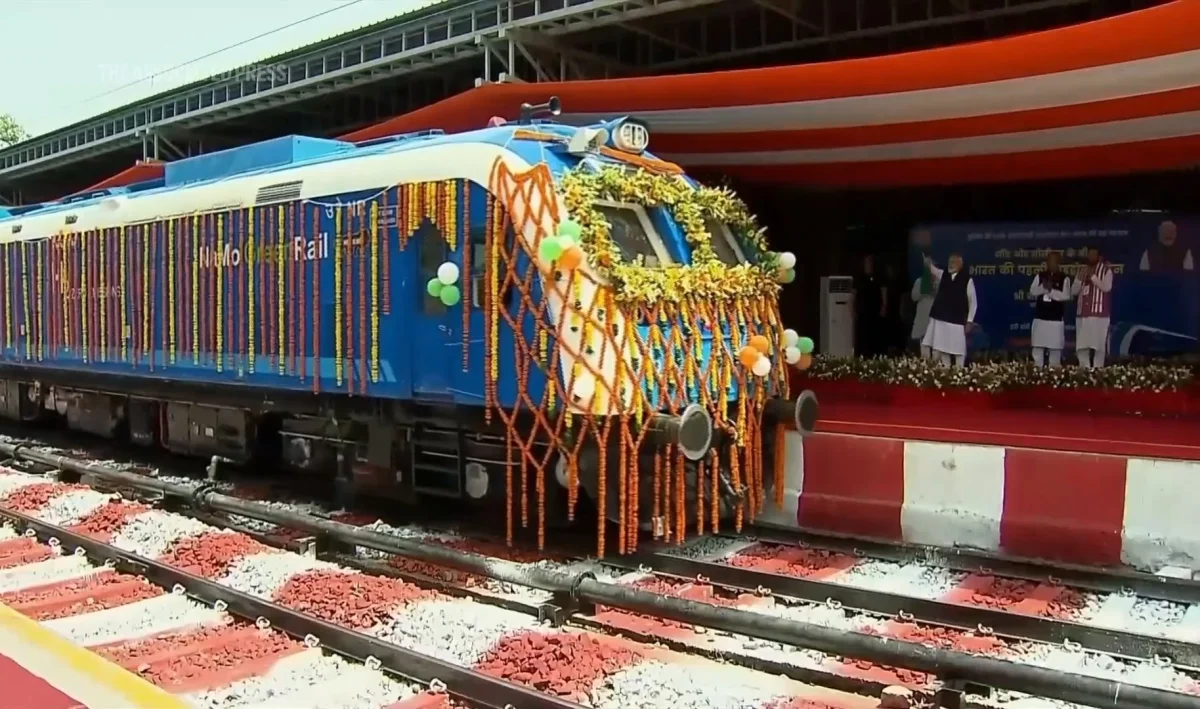
JIND, HARYANA — A decade-long engineering effort culminated on Friday when Indian Railways put its first domestically built hydrogen-powered train into service, giving the country a new entry in the small global club of nations running hydrogen technology on rail.
Built entirely at the Integral Coach Factory in Chennai, the 10-coach "NaMo Green Rail" now holds the record for the world's longest broad-gauge hydrogen train, a distinction that puts India's engineering base alongside Germany, Japan, China and the United States in a technology still considered experimental in most rail networks.
Where It Runs
The service connects Jind and Sonipat in Haryana over an 89-kilometre stretch, making two round trips a day. Two hydrogen-powered driving cars bookend eight passenger coaches, giving the train a capacity of roughly 2,600 riders at a top speed of 75 kph — modest by high-speed rail standards, but sufficient for the regional route it was built for.
Why Hydrogen, and Why Here
Indian Railways has electrified nearly all of its 70,000-km network, one of the largest in the world, but pockets of track remain where wiring isn't practical. Hydrogen fuel cells fill that gap: the only byproducts of running the train are heat and water vapour, offering a diesel alternative without the emissions. The Jind line was chosen partly because a dedicated hydrogen plant was built alongside it, producing fuel on-site through electrolysis and storing up to 3,000 kg at a time. The high-pressure refuelling station that compresses and transfers the hydrogen into the train was engineered by Fluidtron, a Kochi-based firm.
Part of a Bigger Bet
The Jind-Sonipat line is the pilot for Indian Railways' "Hydrogen for Heritage" program, which envisions 35 hydrogen trains eventually running on heritage and hill routes where diesel has long been the only option. Each train set carries an estimated cost of around Rs 80 crore, with a further Rs 70 crore per route for ground infrastructure — part of a roughly Rs 2,800 crore government commitment to the technology. Railway Minister Ashwini Vaishnaw has said the project follows specifications set by the Research, Design & Standards Organisation to test hydrogen propulsion under real operating conditions before wider rollout.
The Political Moment
Prime Minister Narendra Modi inaugurated the service at Jind station, naming it "NaMo Green Rail" — a nod to his own initials — and calling it a marker of progress toward self-reliant, sustainable development. The launch adds to a string of clean-energy initiatives the Modi government has pushed in recent years, from renewables expansion to nuclear power, even as India continues to face criticism over the pace of its broader climate policy.
What's Your Reaction?
 Like
0
Like
0
 Dislike
0
Dislike
0
 Love
0
Love
0
 Funny
0
Funny
0
 Wow
0
Wow
0
 Sad
0
Sad
0
 Angry
0
Angry
0








Comments (0)