
India job creation: The Essential Link to Judicial Reform Success
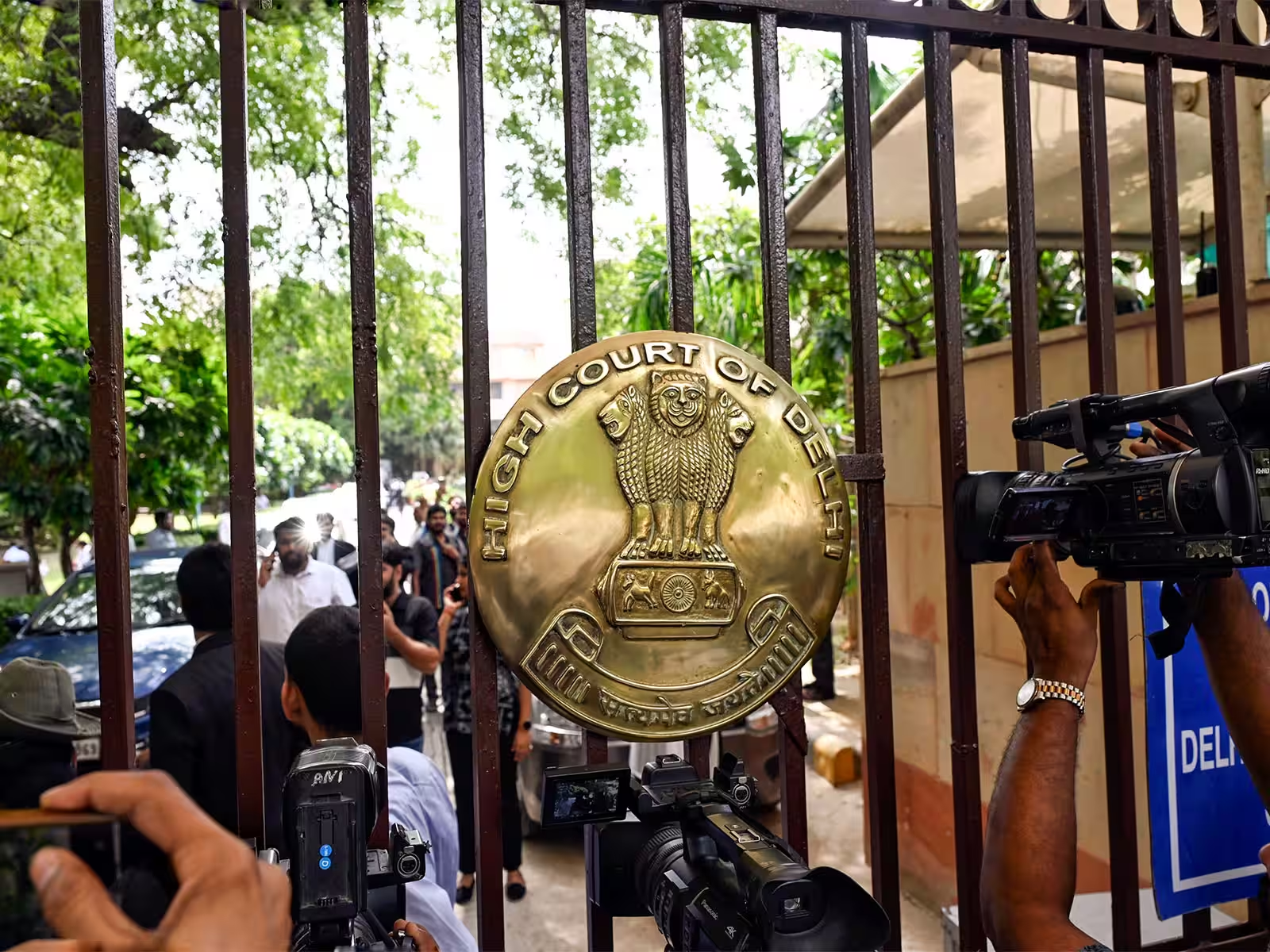
India’s judicial backlog is stifling growth. Can justice reform accelerate India job creation by ending the decades-long wait to enforce contracts?

The backlog of legal cases represents a significant bottleneck for the national economy. We must recognize that india job creation depends heavily on how quickly disputes are resolved. When litigation drags on for decades, the broader market suffers from immense uncertainty.
The Link Between Justice and India Job Creation
Inefficient courts act as a silent tax on productivity and growth. If a business cannot rely on the law, it cannot plan for long-term expansion. This reality makes india job creation a difficult goal to achieve in the current environment.
Contract enforcement india
is a primary concern for investors and business owners alike. When legal resolutions take too long, companies hesitate to scale their operations. We must prioritize indian judicial reform to unlock the full potential of our workforce.
Barriers to Economic Expansion
The persistence of courtroom delays creates a hostile environment for new businesses. These hurdles serve as significant entrepreneurship barriers that discourage innovation outside of major urban hubs. Many talented individuals remain sidelined because the risk of legal disputes is simply too high.
Without a functioning legal framework, capital formation remains sluggish and localized. Investors fear putting money into ventures that cannot be legally protected. Consider how these systemic issues affect the labor market:
- Legal uncertainty prevents small firms from scaling up.
- Long wait times force companies to rely on informal networks.
- Reduced investment leads to fewer roles for young professionals.
Improving these processes is essential for india job creation to reach its target pace. We need a system that supports growth rather than hindering it. Continued progress in india job creation requires a stable foundation of justice.
Addressing the Systemic Crisis
The judiciary must acknowledge its role in the country’s economic health. Policymakers should focus on efficiency to ensure india job creation is not stifled by paperwork. Efficient dispute resolution is a catalyst for prosperity.
Many stakeholders argue that current delays are unsustainable for a growing economy. Reducing the backlog is not just a legal priority; it is an economic imperative. Future success hinges on how we handle india job creation alongside structural legal changes.
We must streamline court procedures to attract more investment. Faster resolutions will naturally lead to more opportunities across the nation. By removing these hurdles, we can finally witness a surge in india job creation.
In conclusion, our justice system must evolve to meet modern economic demands. Swift legal resolution is the backbone of a healthy, thriving market. Prioritizing these reforms will ultimately secure the future of our workforce and ensure long-term stability.
More updates
Follow the latest Law & Gov news and related coverage.
What's Your Reaction?
 Like
0
Like
0
 Dislike
0
Dislike
0
 Love
0
Love
0
 Funny
0
Funny
0
 Wow
0
Wow
0
 Sad
0
Sad
0
 Angry
0
Angry
0

Mohit Saxena covers jobs, recruitment news and career guidance, with special attention to government vacancies. He helps job seekers stay informed about notifications, eligibility and preparation tips. His work is driven by a wish to support young professionals.









Comments (0)