
Ladakh place names: 28 Official Sites Revealed Amid China Tensions
India’s move to standardize 28 Ladakh place names has triggered a sharp rebuke from Beijing, which labels the official mapping effort as invalid.
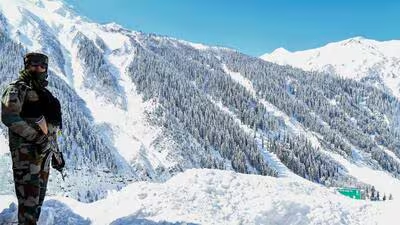
India’s Strategic Move: New Nomenclature in Ladakh Challenges Beijing
Latest on Ladakh Place Names: New Delhi has launched a significant initiative to standardize geographic identifiers across the northern frontier. This effort involves formalizing ladakh place names to align with official state records. Beijing quickly criticized the move, dismissing the process as an invalid attempt to alter regional realities.
The tension highlights ongoing friction regarding the india china border. Officials in India maintain that these changes reflect long-standing territorial sovereignty. By updating ladakh place names, the government seeks to clarify administrative control in a contested zone.
Formalizing Geographic Identity
The mha naming drive officially identified 28 specific locations and geographical features. These sites are now documented according to standard nomenclature found on the survey of india map. This systematic update ensures consistent terminology in all government communications.
Integrating these ladakh place names into official records serves several administrative purposes:
- Enhancing cartographic accuracy for national security.
- Standardizing terminology for regional infrastructure projects.
- Strengthening the official record of the survey of india map.
Authorities emphasize that the list of 28 features is based on verified historical and administrative data. The initiative aims to remove ambiguity surrounding remote areas. Clearer ladakh place names are expected to assist in both governance and logistical planning.
The Diplomatic Friction Over Ladakh Place Names
Beijing responded to this development by labeling the exercise as a futile provocation. Chinese representatives claimed the renaming of ladakh place names lacks any legal basis. They argued that unilateral actions cannot change the status of the geopolitical border dispute.
This standoff adds a new layer to the complex india china relations. Both nations remain deeply entrenched in their respective territorial claims. Frequent diplomatic protests are common whenever one side attempts to assert authority through cartographic updates.
Recent rhetoric from China suggests a refusal to recognize the legitimacy of the mha naming drive. They maintain that such designations are invalid under their own interpretations of the frontier. India continues to reject these objections, citing its sovereign rights over the region.
Implications for Regional Security
The persistent geopolitical border dispute continues to influence military and diplomatic strategy. Analysts view the standardization of ladakh place names as a soft power assertion. It signals that New Delhi intends to maintain its administrative footprint despite external pressure.
Efforts to solidify india china relations remain hampered by these recurring naming controversies. Each side views the other's maps as a direct challenge to their territorial integrity. The focus on ladakh place names highlights how deeply cartography is linked to national pride.
The international community continues to monitor these developments closely. Any shift in how the frontier is mapped often draws immediate reactions from both capitals. Future stability may depend on how both nations navigate these sensitive administrative claims.
In conclusion, the recent naming initiative represents a firm stance by India regarding its northern territories. While China labels the process as invalid, the government remains committed to its official cartographic standards. This ongoing cycle of naming and protesting underscores the fragility of the current status quo.
More updates
Follow the latest India news and related coverage.
What's Your Reaction?
 Like
0
Like
0
 Dislike
0
Dislike
0
 Love
0
Love
0
 Funny
0
Funny
0
 Wow
0
Wow
0
 Sad
0
Sad
0
 Angry
0
Angry
0

Vikram Singh is a sports journalist who has followed cricket and football from local grounds to international stadiums. His match reports and player profiles capture both the numbers and the emotion of the game. He is passionate about grassroots sport and young talent.



Comments (0)