
The Original 'Hollywood' Wasn't in America—It Was in Medieval Baghdad
Long before cameras existed, medieval Baghdad's storytellers invented the cliffhanger with One Thousand and One Nights — the true origin of Aladdin and modern franchise storytelling.

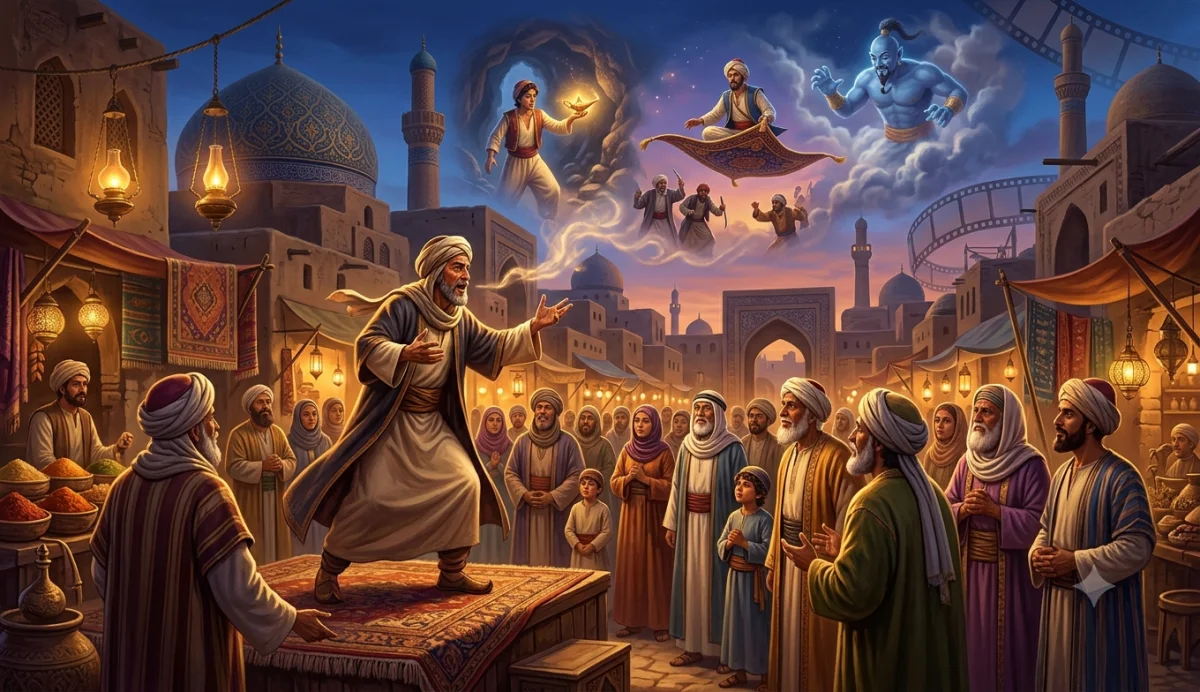
KOLKATA — When modern audiences pack theaters for global blockbusters like Aladdin or recognize names like Ali Baba, they are engaging with a billion-dollar entertainment industry dominated by American studios. But a closer look at history shows the actual blueprint for these stories — and the concept of serialized entertainment itself — was invented over a thousand years ago in the Middle East.
During the Islamic Golden Age, the Abbasid Caliphate made Baghdad its capital. Widely celebrated as a global center for science, mathematics and philosophy, the city also quietly gave rise to what historians might consider the world's first storytelling industry, long before the camera was invented.
The Rise of the Hakawati
As scholars, merchants and travelers converged on Baghdad from Europe, Africa and Asia, they brought their local folklore with them. This cultural mixing gave rise to a new class of professional storytellers known as hakawatis. Much like modern actors and directors, they performed in Baghdad's bustling marketplaces, drawing large crowds — their livelihood depended entirely on holding an audience's attention. As listeners grew accustomed to familiar tales, storytellers faced a challenge: they needed a device that would keep audiences coming back day after day.
Birth of the Cliffhanger
Their answer was a literary masterpiece that introduced the cliffhanger to the world: One Thousand and One Nights (Alf Layla wa-Layla). The frame story follows King Shahryar, embittered by betrayal, who vows to marry a new woman each night and have her executed by morning. To end the bloodshed, Scheherazade, the vizier's daughter, volunteers to marry him. Each night she tells a captivating story and stops right at its climax as dawn breaks — and each morning, Shahryar spares her life to hear how it ends. Embedded within her nightly tales were the origins of Aladdin, Ali Baba and the Forty Thieves, and stories of djinns and magical kingdoms.
Destruction and Survival
This storytelling economy was devastated in 1258, when Hulagu Khan's Mongol forces sacked Baghdad, destroying its great libraries — according to accounts, so many books were thrown into the Tigris that the river ran black with ink. Yet the stories survived because they had already been woven into oral tradition, allowing them to travel across borders and eventually reach Europe, where they were translated into French in the early 18th century.
From Baghdad to Hollywood
Centuries later, as American cinema emerged, early filmmakers turned to these surviving tales. Aladdin and the Wonderful Lamp, a silent film based on the story, was released in the United States in 1917. Today, Western studios continue to generate billions of dollars repackaging these ancient narratives — but the true roots of modern franchise storytelling trace back to the medieval marketplaces of Baghdad.
What's Your Reaction?
 Like
1
Like
1
 Dislike
0
Dislike
0
 Love
0
Love
0
 Funny
0
Funny
0
 Wow
0
Wow
0
 Sad
0
Sad
0
 Angry
0
Angry
0







Comments (0)