
Puri Braces for Over 1 Million Devotees Ahead of Grand Jagannath Rath Yatra
The coastal city of Puri is bracing for its biggest event of the year as over a million devotees are expected to gather on July 16, 2026, for the grand Jagannath Rath Yatra. The ancient festival, which marks the annual journey of Lord Jagannath and his siblings to their aunt's temple, brings centuries-old traditions to life. The event is defined by unique cultural highlights, including the construction of massive nail-less wooden chariots and the symbolic sweeping ritual performed by the Maharaja of Puri.

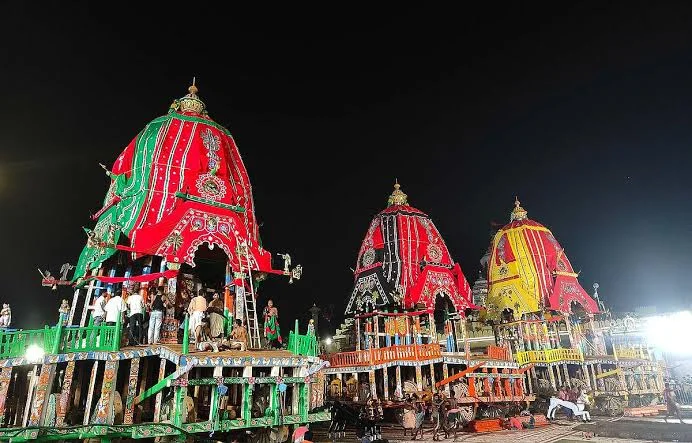
PURI — The coastal town of Puri is set to transform into a sea of intense devotion on July 16, 2026, as over one million pilgrims arrive to witness the grandeur of the annual Jagannath Rath Yatra. As one of India's oldest and most massive public festivals, the Rath Yatra marks the rare occasion when Lord Jagannath steps out of his inner sanctum alongside his siblings, Lord Balabhadra and Goddess Subhadra, to travel openly among the masses.
The spectacular journey, which mythologically symbolizes Lord Krishna's voyage from Gokul to Mathura, sees massive hordes of devotees pull three towering chariots over a distance of roughly one mile. Their destination is the Gundicha Temple, considered the deities' aunt's summer cottage, where they will reside for a nine-day period before embarking on their return journey.
Centuries-Old Engineering and Traditions
The Rath Yatra is defined by its fascinating, deeply entrenched engineering and ritualistic guidelines:
-
Nail-Less Chariot Construction: Unlike many temple deities whose vehicles are preserved and reused, the massive Puri chariots—named Nandighosha, Taladhwaja, and Darpadalana—are built entirely from scratch every single year. Each structure is distinctly color-coded with specific dimensions. Master artisans employ age-old wooden joinery techniques to construct the majestic wooden chariots without using a single metal nail.
-
The Anasara Period: The festival is preceded by a strict 15-day isolation period known as Anasara. Following the Snana Yatra (annual bathing ceremony), the deities are said to fall sick and are kept completely hidden from public view. Their emergence on the day of the Yatra offers the only opportunity of the entire year for a close public darshan, making it highly sacred for devotees.
Symbolism and Royal Humility
Beyond the massive scale, the festival serves as a powerful symbol of universal equality and social harmony. Before the grand procession officially begins, the Gajapati Maharaja of Puri performs the highly revered Chhera Pahanra ritual. During this ceremony, the king cleanses the chariots using a golden broom, publicly demonstrating that everyone—from a royal king to a common citizen—is completely equal in the eyes of God.
The festivities will continue to evolve during the deities' extended stay and return journey, featuring dramatic, narrative customs. These include the Hera Panchami ritual, which depicts Goddess Lakshmi’s mock anger and displeasure at being left behind at the main temple, and the Suna Besha, where the deities are decked in magnificent gold ornaments to display their supreme majesty. With a massive outpouring of devotion, the Rath Yatra remains an unmissable cultural spectacle.
What's Your Reaction?
 Like
0
Like
0
 Dislike
0
Dislike
0
 Love
0
Love
0
 Funny
0
Funny
0
 Wow
0
Wow
0
 Sad
0
Sad
0
 Angry
0
Angry
0






Comments (0)