
The Evolving Political Landscape of Jhansi for upcoming elections in 2027.
As Uttar Pradesh prepares for the crucial 2027 Legislative Assembly elections, Jhansi has emerged as a key political battleground. The ruling Bharatiya Janata Party (BJP) faces stiff local anti-incumbency, with public surveys indicating a strong demand for fresh candidate faces. Concurrently, the Samajwadi Party (SP) and Congress are solidifying their INDIA bloc alliance to leverage a calculated combination of Brahmin, Dalit, and non-Yadav OBC votes. Ground reports indicate a direct, fierce contest between the BJP and the SP-Congress coalition across Jhansi’s primary constituencies, focusing heavily on local governance, infrastructure failures, and rural agrarian distress.

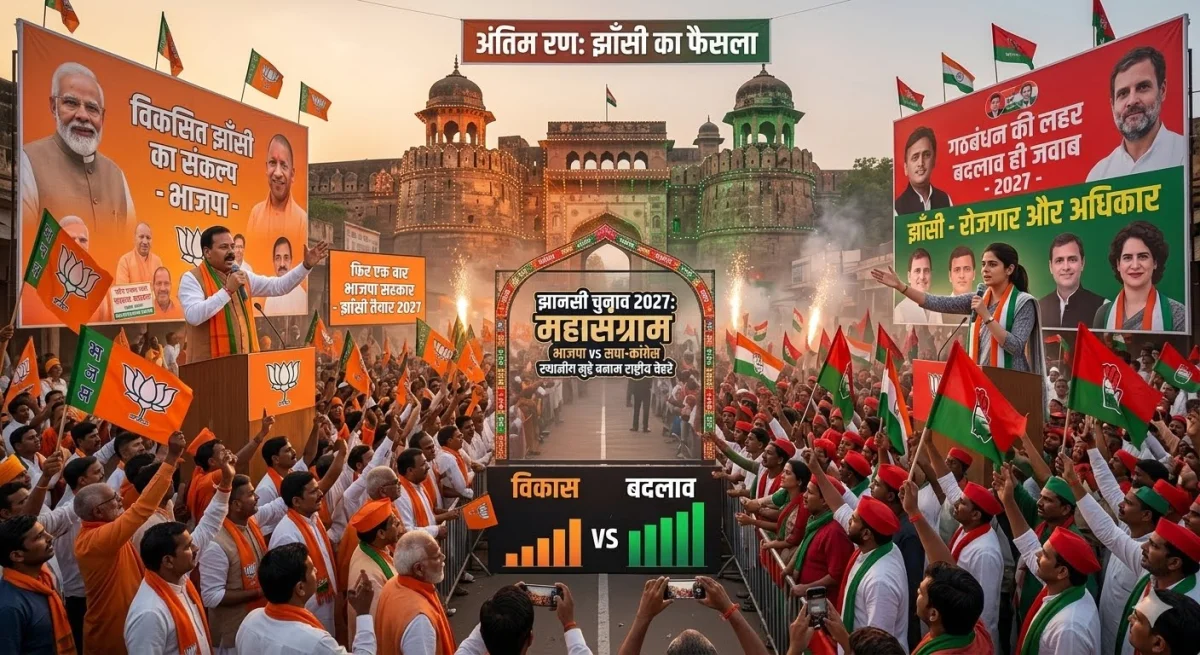
Battle Lines Drawn: High-Stakes Alliances and Local Anti-Incumbency Heat Up Jhansi Ahead of 2027 UP Assembly Elections.
With the Uttar Pradesh Legislative Assembly elections scheduled for early 2027, the historic city of Jhansi is witnessing an early and intense political churn. As the gateway to the Bundelkhand region, Jhansi's four key assembly seats—Jhansi Sadar (Nagar), Babina, Garautha, and Mauranipur—are crucial for any party aiming to control the 403-member state assembly.
G-Incumbency Testing the BJP's Stronghold:- The BJP has long enjoyed a dominant position in Jhansi Nagar, where sitting MLA Ravi Sharma secured a resounding victory in 2022 with a margin of over 76,000 votes against SP's Sita Ram Kushwaha. However, regional ground reports show a different narrative for 2027.
According to recent local public surveys, over half of the polled constituency expressed a desire for the BJP to replace its sitting candidate due to visible anti-incumbency. While voter loyalty toward the broader development agenda of Chief Minister Yogi Adityanath remains intact, local dissatisfaction over municipal governance has put the party on high alert, sparking speculation about a massive shake-up in ticket distributions.
SP-Congress Coalition Fine-Tunes the Social Equation:- Recognising a window of opportunity, opposition forces are consolidating rapidly. Samajwadi Party chief Akhilesh Yadav has declared that the SP-Congress alliance will remain unified for 2027, focusing purely on candidate winnability rather than rigid seat-sharing quotas.The opposition is heavily banking on a strategic caste combination. Jhansi features a substantial voter base comprising Brahmins, Dalits (such as the Ahirwar and Kori communities), and non-Yadav OBCs. Senior journalists tracking local developments via regional networks note that Congress leader and former Union Minister Pradeep Jain Aditya is generating significant public traction. If field as a unified coalition face, his local standing could pose a severe threat to the BJP's traditional vote bank.
Ground Triggers: Rural Distress vs. Industrial Development :- The electoral narrative in Jhansi is splitting along urban-rural lines. The ruling party is actively campaigning on infrastructure projects, including highway expansions and the flagship Bundelkhand Industrial Development Authority (BIDA) initiative.However, opposition groups are focusing on the rural belts of Babina and Garautha. Ground realities regarding irregular power supply, lack of youth employment, inflation, and unresolved agrarian issues are being highlighted to sway voters away from the ruling mandate.As political outfits intensify grassroots surveys to filter potential candidates, Jhansi is braced for a highly competitive campaign where local candidate performance may ultimately overshadow national mandates.AI can make mistakes.
What's Your Reaction?
 Like
1
Like
1
 Dislike
0
Dislike
0
 Love
1
Love
1
 Funny
0
Funny
0
 Wow
0
Wow
0
 Sad
0
Sad
0
 Angry
0
Angry
0



Comments (0)