
Dixon Share Price Jumps 5% on Massive ₹1.9 Lakh Crore Mobile & Semiconductor Policy Push
The dixon share price rallied 5% today to trade at ₹14,260.0, significantly outperforming the broader market during intraday trading. The sharp upward movement follows the Union Cabinet's approval of two massive manufacturing initiatives—the ₹1.27 lakh crore Semicon 2.0 program and the ₹62,500 crore Mobile Phone Manufacturing Scheme (MPMS). While the stock currently trades at a P/E ratio of 53.7, this policy-driven optimism comes after a challenging 12-month period where Dixon underperformed its sectoral index.

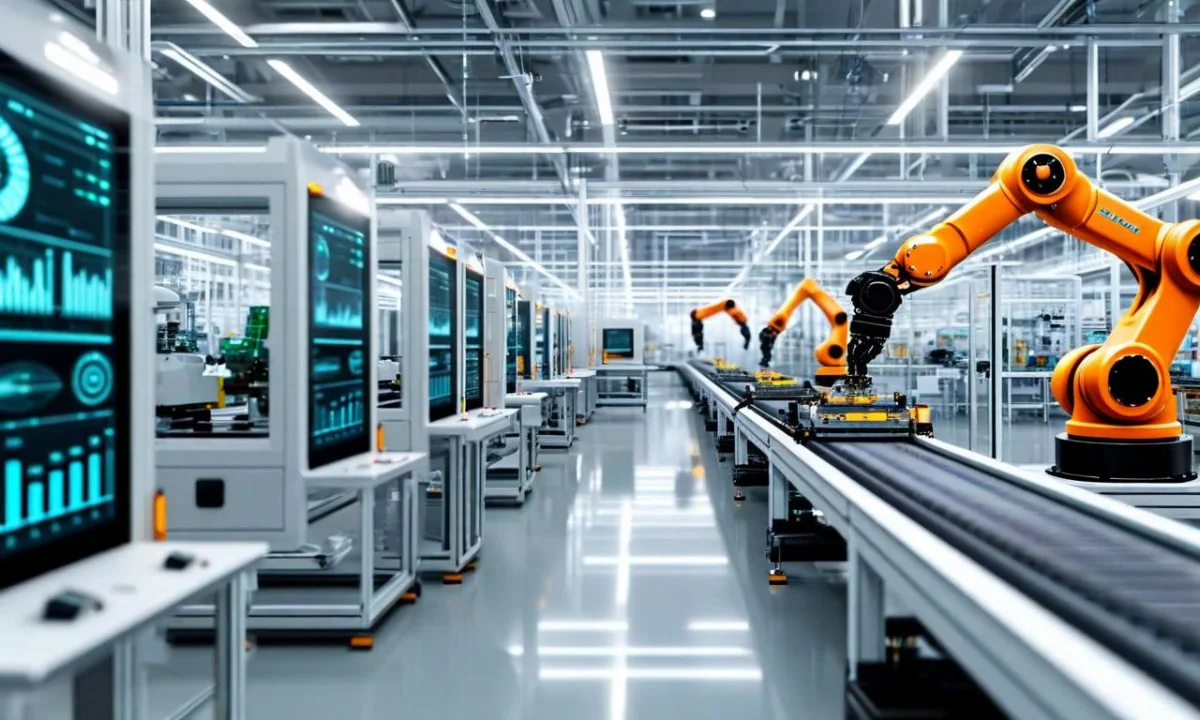
MUMBAI — Shares of contract electronics manufacturing services (EMS) giant Dixon Technologies (India) Ltd. witnessed strong buying traction today, surging 5% to trade at ₹14,260.0 per share. The stock significantly outpaced the broader market, driven by a highly favorable regulatory announcement that positions the company as a primary beneficiary of India's tech manufacturing expansion.
The sharp intraday rally was triggered by the Union Cabinet's formal approval of two interconnected manufacturing programs with a combined layout of nearly ₹1.9 lakh crore. These initiatives are designed to fundamentally upgrade the domestic semiconductor infrastructure and deepen local supply chain integration for consumer electronics.
The Policy Catalyst and Market Impact
Market participants aggressively accumulated the stock following the announcement of the following production incentives:
-
Semicon 2.0 Program: Approved with a massive budget allocation of ₹1.27 lakh crore to establish an end-to-end semiconductor design and fabrication ecosystem.
-
Mobile Phone Manufacturing Scheme (MPMS): Cleared with a ₹62,500 crore framework aimed at accelerating localized electronics components manufacturing and expanding domestic phone production.
As a leading original design manufacturer (ODM) for international and domestic tech brands, Dixon Technologies stands to secure substantial fiscal and production-linked tailwinds under these schemes. Following today's price surge, the stock currently commands a Price-to-Earnings (P/E) ratio of 53.7, based on rolling 12-month earnings.
Financial Performance Trajectory
The policy-induced breakout offers a brief reprieve from recent earnings adjustments. For the quarter ended March 2026, Dixon reported a 36.6% year-on-year drop in consolidated net profit to ₹2,923 million, down from ₹4,612 million in the corresponding period of the previous year. However, operational net sales managed a modest rise of 2.1% to reach ₹105,105 million.
This temporary quarterly compression stands in sharp contrast to a spectacular full-year FY25, where the company showcased exceptional scalability. In FY25, the firm logged a 228.8% explosion in annual net profit to ₹12,326 million, alongside a massive 119.7% jump in operational revenue to ₹388,601 million.
Sectoral and Benchmark Divergence
Dixon's intraday breakout served as a vital anchor for the BSE Consumer Durables Index, which traded up 0.8% at the 63,217.6 mark. Top sectoral gainers alongside Dixon included Rajesh Exports (up 1.0%) and Titan Company (up 0.8%), while Blue Star (down 0.8%) and Amber Enterprises India (down 0.4%) ended the session as the primary laggards.
Despite today's 5% jump, the stock's longer-term performance reveals notable room for catch-up. Over the past 12 months, the BSE Consumer Durables index has climbed 5.9%, heavily supported by individual outperformance in stocks like Titan (up 35.5%) and Vaibhav Gems (up 7.6%). In stark contrast, Dixon Technologies has lost 10.3% of its market value over the exact same 12-month window, dropping from a high base of ₹15,899.0.
In the broader markets, the benchmark indices mirrored a cautious but positive tone. The BSE Sensex traded higher by 0.3% at 77,380.6, lifted by gains in HCL Technologies and Mahindra & Mahindra, while the NSE Nifty stood up 0.2% at 24,128.1. Over a 1-year horizon, the benchmark Sensex continues to trade with a cumulative loss of 5.9% (down 4,872.9 points), underscoring the macroeconomic headwinds the manufacturing sector has had to navigate.
What's Your Reaction?
 Like
0
Like
0
 Dislike
0
Dislike
0
 Love
0
Love
0
 Funny
0
Funny
0
 Wow
0
Wow
0
 Sad
0
Sad
0
 Angry
0
Angry
0









Comments (0)